The process of transmediation is to translate something from one sign system to another sign system.
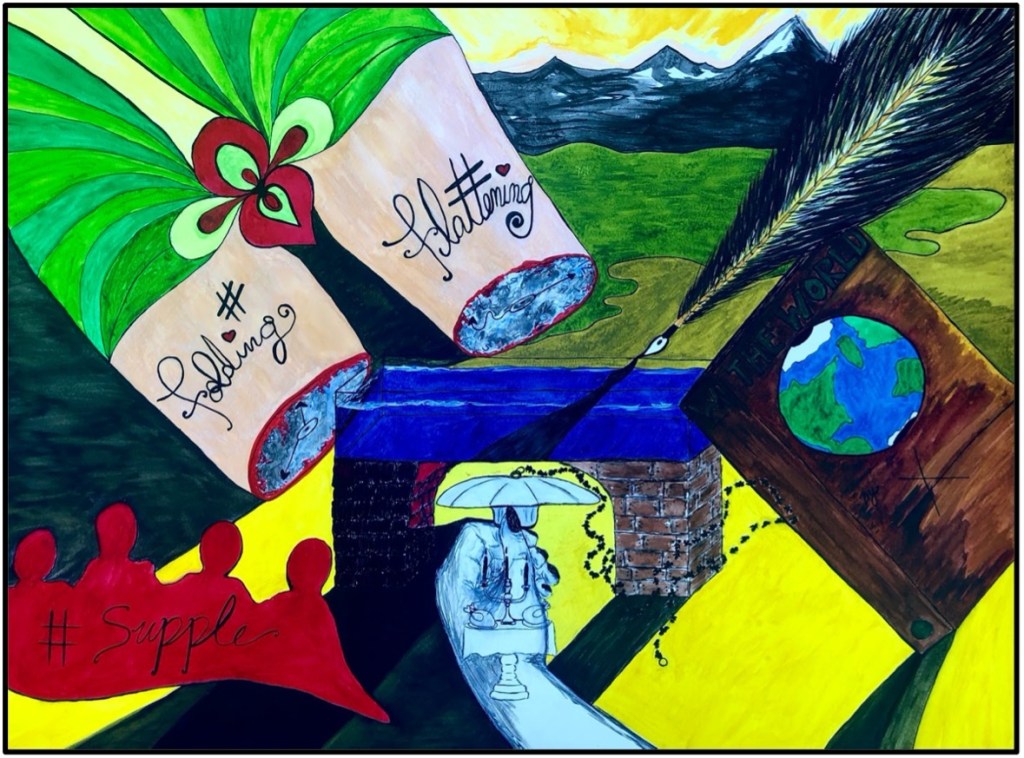
I created Plugging-Into the Threshold of the Assemblage as I read, contemplated, and sketched what I believed embodied the concepts I encountered in Chapter 1 of Jackson and Mazzei’s (2012) Thinking with Theory for Qualitative Research. The authors challenge the reader to prepare their mind for an experience that rejects the normal pathways of analysis and endeavors to find the extraordinary through the use of thinking with theories and data together.
Jackson and Mazzei propose the mind-bending process of “plugging in.” A chaotic process of making and unmaking, folding and flattening, of plugging into multiple machines in an assemblage of organizing, arranging, and fitting together. They pose that “to see it at work, we have to ask not only how things are connected, but also what territory is claimed in that connection” (p.1). Understanding what that means can be daunting. Negotiating that meaning using transmediations makes it clearer.
Here the assemblage is represented by the coming together of an arch. Red bricks, wood two-by-fours, and a glass fish tank unite. Beneath the arch is the entrance and exit of the threshold, where a hand is holding a bathtub plug. The torso of a woman sits in the top left. Her legs severed at mid-thigh, revealing a pair of blue-grey dream spaces with the hands and numbers of clock faces. Two tattoos read #folding and #flattening to represent the process by which new ideas are found within the folds of deconstruction and reterritorialization. The landscape of green pastures and glowing mountain-scape emphasize the connections between these ideas and the movements of literal and figurative “decolonization of territories.”
The images are surreal, open for interpretation, living for and against interpretivism, a true visual feast of ideas from the Chapter. How these elements relate and how we choose to examine them can be guided or left to the imagination.
 kristenfung.com